


Internal Wall Insulation in Musselburgh: Old Walls Kept Dry, Rooms Kept Warm
You pay no deposit for internal wall insulation in Musselburgh or Inveresk, and the invoice arrives on 7-day terms once the work is finished.
Google Review
-
Stripped to the stone
-
A lime parge
-
Hemp in the frame
-
Wood-wool board
-
Lime plaster with mesh
-
Finished and painted
 Illustration: a vapour-open system on a stone wall
-
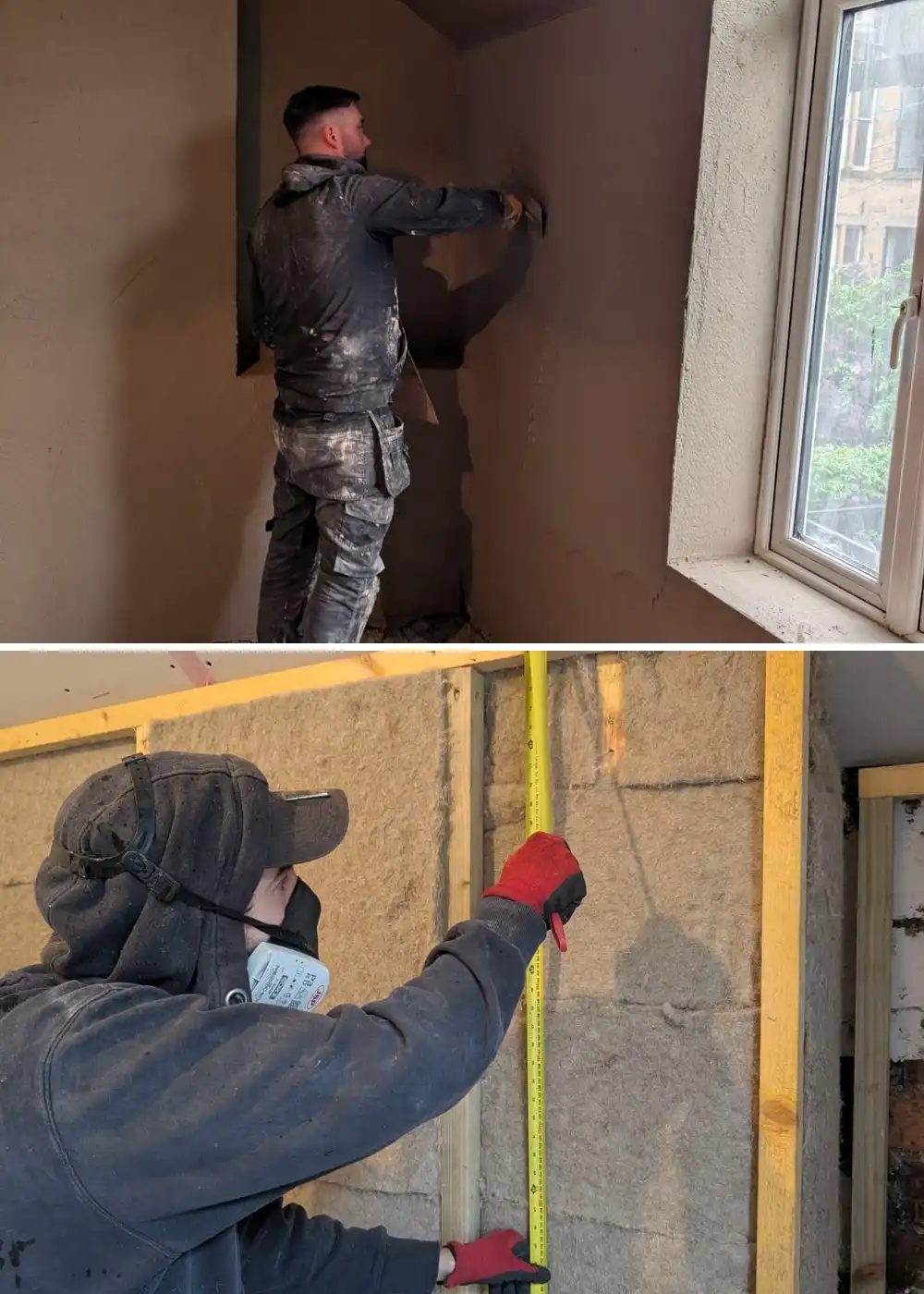
Stripped to the stone
-
A lime parge
-
Hemp in the frame
-
Wood-wool board
-
Lime plaster with mesh
-
Finished and painted


Musselburgh Grew as Three Different Towns, and the Walls Still Show It
Two questions usually come up before the price on a cold Musselburgh stone house. Will insulating the inside trap damp in the wall, and will your cornicing survive?
-
Fisherrow’s old fishing cottages, the stone terraces and flats of Newbigging and the older townhouses in Inveresk are all solid stone, but each was built its own way, so internal wall insulation in Musselburgh starts with which of them you own.
-
The cheap way of insulating stone walls in Musselburgh is foil-backed plastic foam board glued to the stone in dabs.
-
That board seals in a wall that needs to keep letting damp out.
-
The damp then has nowhere to go, and it shows up as mould behind the new plaster or rot in the joist ends.
More than 30,000 homes are affected, per the National Audit Office’s October 2025 findings on ECO4 and GBIS: major defects turned up in around 98% of the external wall insulation checked and 29% of the internal wall insulation.
You want warm rooms, your cornicing back and a sound wall behind it.
That takes tailored solid wall work, so we design period property insulation here wall by wall and price it from a survey of your own house.
Many people search for ‘breathable insulation’.
The trade term is vapour-open, which means moisture keeps moving out through the wall on its own, and our internal wall insulation service is built on it.
Your cornicing comes back in lime, and the old stone goes on drying behind warm rooms.


Our process
Our Simple Process
We start with a free survey of your walls, and you see the two systems we fit before anyone strips a wall.
-
Step 1
Free survey and tailored design
A surveyor visits in person to check how the wall is built, how exposed it is and whether damp is already present. Calum specifies the build-up from our WUFI-validated library, and every quote sets out the options side by side.

-
Step 2: the split
The honest comparison
Your wall’s material, finish and modelling decide which of these two systems suits it.
-
Right for most stone
Natural system that lets stone dry
Lime + hemp or wood wool
Illustration: vapour from the room passes through each layer and the stone keeps drying. - + The wall keeps drying out
- + Can mostly be taken out again later, and keeps the stone healthy
- + Right for most solid sandstone walls
- − Costs more, takes longer, more prep
- − Slightly more room lost to depth
-
On the right wall
Membrane system that keeps room moisture out
Pro Clima membrane + insulation
Illustration: the membrane holds vapour from the room back, before it reaches the wall. - + For brick that soaks up little water, or brick that is rendered or painted
- + Can be thinner in some cases
- − Only used where our moisture modelling shows it is safe
- − Wrong for a normal sandstone wall, which soaks up water
-
-
Step 3
Specialist installation
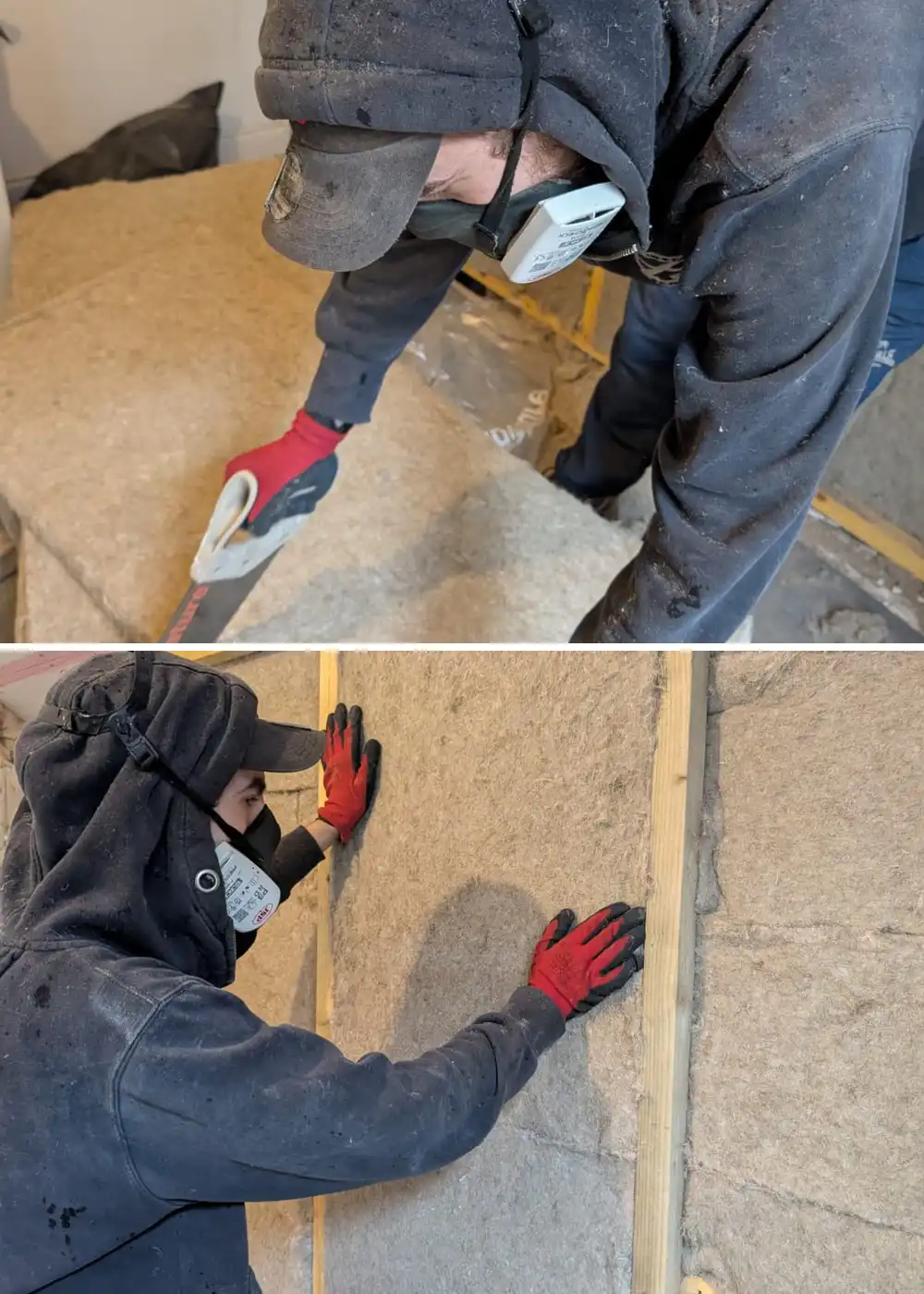
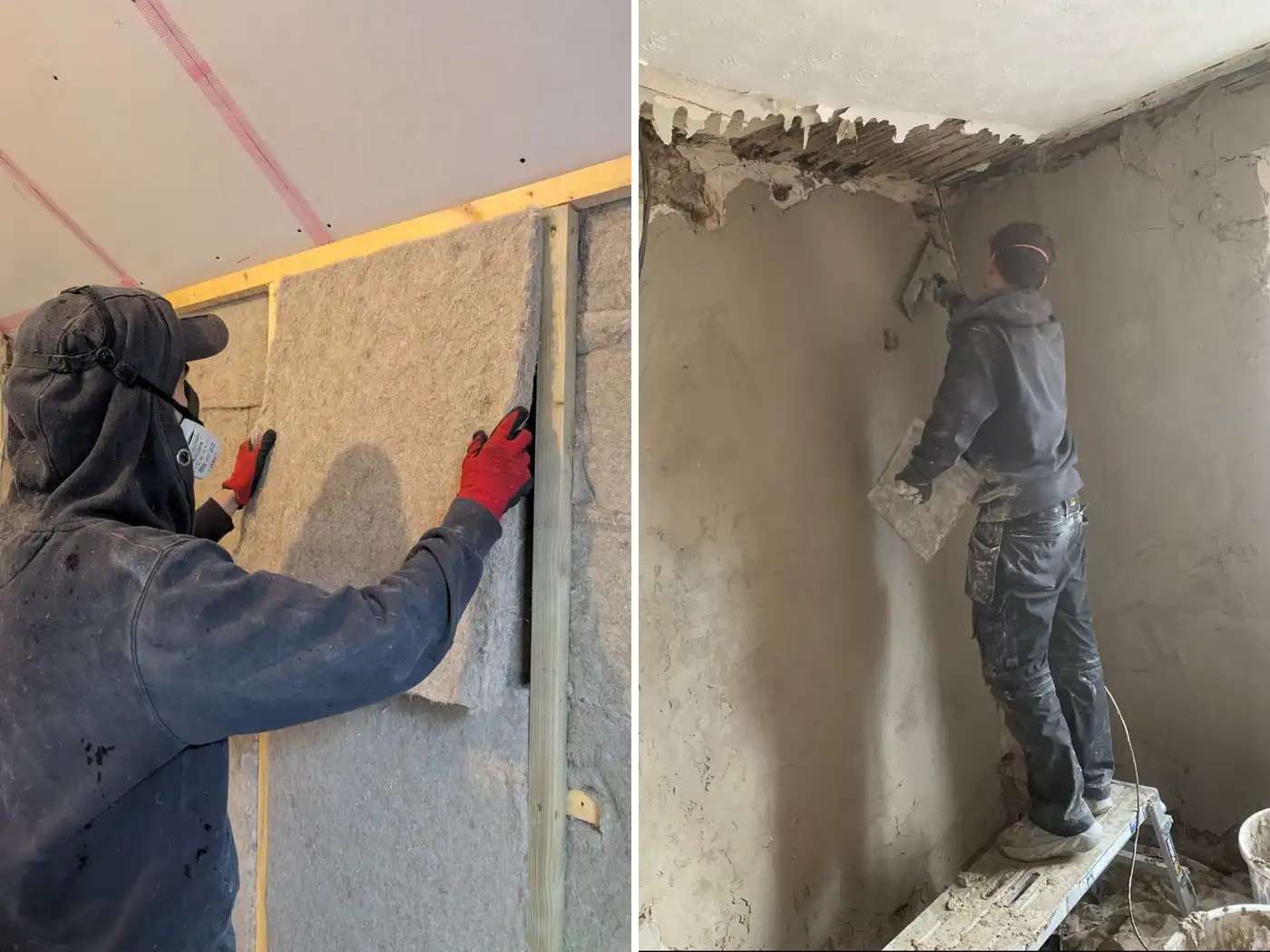
Our installers strip the wall back, and our lime plasterer lays the parge coat before our fitters build the frame and fit the hemp and wood wool. The plasterer then comes back for the finish coats. Lime needs proper curing time, so the job phases across several weeks.

-
Step 4
Aftercare and guarantee
When the lime plaster cures, we walk the finished rooms with you, hand over the photographs and paint guidance, and the job carries our 25-year workmanship guarantee.
-
Our line in the sand
What we will not do
Sealed foam on solid sandstone
We won’t glue a sealed polystyrene or foam board onto a solid sandstone wall to bring the price down. If that’s what it would take to land a cheaper number, we’ll tell you honestly and recommend against it.
Next step
Start with the survey
Learn what your Musselburgh walls need before anything comes off them.
Calum or Lewis tells you which cornicing comes down and how it gets remade before you agree to anything.
Book Your Free Survey ↓

Inside the wall
Your wall, insulated layer by layer
Each card shows one build going onto a wall, from bare masonry to a finished room, in the order our fitters work. The pictures are illustrations.
Illustration: heritage system
-
Stripped to the stone
Our fitters strip the old plaster and timber laths back to bare sandstone, so no hidden wood is left to rot. Cornicing on these walls comes down too, and is remade in lime after the insulation goes in.
-
A lime parge
Then a coat of lime, called a parge, goes over the stone. It fills the hollows where damp air could sit and turn to water.
-
Hemp in the frame
Our fitters press two 50mm layers of Scottish-made IndiTherm hemp into a 45mm timber frame fixed over the lime. This is the layer that keeps the heat in your room.
-
Wood-wool board
Wood-wool board, a stiff sheet of bound wood shavings, goes over the hemp next. It gives the lime plaster a solid face to grip and still lets moisture pass through.
-
Lime plaster with mesh
Lime plaster goes on next, with a mesh bedded into it.
-
Finished and painted
A smooth lime finish leaves the wall about 120mm further into the room than before. At handover you get paint guidance, so the finish keeps letting the wall dry.
Hemp, wood wool and lime on bare sandstone
This vapour-open build suits most solid sandstone walls. Each layer lets moisture pass, so the stone behind it can keep drying out.
 Illustration: membrane system
-
Stripped back to brick
The old plaster comes off the inside of the wall, back to the brick.
-
Hemp packed into a frame
Our fitters pack hemp insulation into a timber frame fixed over the brick.
-
The Intello Plus membrane
A Pro Clima Intello Plus membrane goes across the frame to keep room moisture out of the wall.
-
Plasterboard and skim
Plasterboard goes over the membrane, and a skim coat finishes the wall.
Hemp and a membrane for the right brick wall
Some walls are brick, and where that brick is rendered or takes up little water, a sealed build can suit it better.
It finishes in plasterboard and a skim coat, so it goes in faster than the lime build.
At your survey, Calum or Lewis checks each outside wall, and Calum tells you which build each one suits.
Why Musselburgh Homeowners Choose Us for Internal Wall Insulation
Your Musselburgh wall gets a build-up designed for how it handles water.
-

Stripped back to stone, then built up in layers
Bare stone is the starting point. Our lime plasterer adds a lime parge coat, then our own fitters build up two 50mm courses of IndiTherm hemp, made in Scotland by IndiNature, in a 45mm timber frame. A 15mm wood-wool board and two coats of mesh-reinforced lime plaster finish it.
-

Moisture evidence from a validated library
Every vapour-open wall insulation build-up we specify comes from a library of WUFI-validated designs covering rubble stone, ashlar and later brick additions, useful if a conservation officer or HES assessor wants the choice justified.
-

Honest options where a wall calls for them
Bare stone in reasonable condition takes the vapour-open build described above. Rendered or low-absorption brick, common on later additions, can call for a vapour-closed build-up instead: hemp in a timber frame, a Pro Clima Intello Plus membrane, plasterboard skim. Both get costed and written down.
-

What happens to your cornicing
Cornicing on an external wall doesn’t survive a strip-back left in place. It comes down before the wall gets built back out. It is recreated in lime once the insulation is in, and at the survey we agree exactly who does that work. The room keeps its detail, just a little less depth.
-

No surprise costs after survey
Every quote sets out the build-up options and the price side by side before you commit, covering the vapour-open route and the vapour-closed alternative where the wall calls for it. You see every option’s price before you decide, including the ones we would not pick first.
-

We are honest about the drive
We are based in East Kilbride and won’t pretend Musselburgh is round the corner. Our installers cover Edinburgh and the Lothians, Musselburgh included, the same territory as our internal wall insulation work in Edinburgh. Price, guarantee and team stay the same.
The honest bit: period features
Cornicing, shutters and panelling on the walls we insulate come off and cannot be saved. The plaster mouldings are recreated in lime once the internal wall insulation is in, and at the survey we agree exactly who does that work, including the timber.
Solid Wall Insulation Cost and the Home Energy Scotland Grant in Musselburgh
Solid wall insulation on an old Musselburgh stone house runs £10,000 to £50,000, and a typical job sits between £14,000 and £25,000.
The final cost comes down to how many outside walls need lining and the state of the stone, and your quote sets that out before you commit.
- GrantUp to 75%, if you qualify
- Walls cap£7,500 in any postcode
- LoanOptional, interest-free, up to £2,500
- InstallerTrustMark-registered
If you qualify, the grant covers up to 75% of that cost, capped at £7,500, which would leave about £6,500 to £17,500 to pay.
- Solid wall insulation qualifies for the Home Energy Scotland grant, and wall work is capped at £7,500 in any postcode.
- We don’t assume Musselburgh or Inveresk postcodes qualify, so budget on £7,500 until HES confirms otherwise.
- An optional interest-free loan of up to £2,500 for solid wall insulation can sit alongside the grant.
- TrustMark registration is required, which we hold, and we are PAS 2030 accredited.
- HES administers the application and decides eligibility, and qualification isn’t guaranteed.
Eligible rural and island postcodes can reach a £9,000 cap for the whole property, but only if you insulate your walls and another part of the house as well.
Rated 5.0 on Google by homeowners across central Scotland.


Why vapour-open, and why it matters for Scottish stone.
-
1Bare solid stone
Solid sandstone and rubble-stone walls manage water the way they always have: they absorb it and let it evaporate off both faces. No cavity, no membrane, no plastic. That works indefinitely, as long as the wall can keep drying.
-
2Foil-faced foam board
Foil-backed plastic foam board or sealed foam stuck straight onto the inside of the wall breaks that. It creates a cold, sealed layer where warm internal moisture reaches the stone, condenses, and has nowhere to go. That trapped condensation is the actual mechanism behind the damp people blame on insulation.
-
3Vapour-open build-up
A vapour-open system (lime, hemp, wood wool) lets that vapour pass through instead. Designed for the wall in question, it stays warm and keeps drying. Ask any installer who designed their build-up for your wall, because that answer matters more than the brand.
Internal wall insulation in Musselburgh: calculated, not guessed.
Our designs are built on WUFI modelling, simulating heat and moisture moving through a build-up over several years, the time a solid wall actually needs to dry to equilibrium: roughly five years for brick, ten for stone.
-
About 5 yearsbrick, drying to equilibrium
-
About 10 yearsstone, drying to equilibrium
Your stone wall is matched to a build-up we have already modelled, so we can show you the modelled moisture result for a wall like yours before work starts.
Ask your own questions about internal wall insulation in Musselburgh.
Tell us which wall worries you, wherever in Musselburgh it sits, and Calum or Lewis will look at it with you at your free survey, or call us to talk it through first.
Ballagan Farm, Strathblane
A full renovation of a two-storey farmhouse where the walls were damp from being poorly insulated. We stripped them back to the bare stone, parged them in lime, then insulated with IndiTherm hemp and wood-wool boards before finishing in lime plaster across both the sloping ceilings and the solid sandstone walls. The loft was insulated with Knauf Earthwool 44.
Auchinlay House, Dunblane
An internal wall and room-in-roof project for a homeowner preparing to install a heat pump and make the bedrooms comfortable year round. We used a vapour-permeable build-up of hemp, wood-wool board and lime plaster on the walls, paired with a vapour-closed system of PIR and Superfoil SF19+ on the sloping ceilings and dormers, plus Knauf Earthwool in the upper loft space.
Mount Hope, Bridge of Allan
The client was renovating an old sandstone wing of their period property. We installed a vapour-permeable system of 100mm Sisalwool, wood-wool board and lime plaster across four walls, including one large gable wall where the dropped ceiling was removed to create an insulated vaulted ceiling.
Belhaven Terrace Lane, Glasgow
A West End client looking to improve thermal performance across the whole home. The property was given internal wall insulation across the ground floor and room-in-roof insulation in the upstairs bedrooms. A vapour-open design for the stone walls was paired with vapour-closed insulation in the sloping ceilings, keeping the high-absorption sandstone able to dry while stopping warm, moist air reaching the roof spaces.
Observatory Lane, Glasgow
An internal wall insulation project carried out for a client of Oscar J Murray Architects as part of a whole-house renovation in Glasgow’s West End. We used IndiTherm hemp insulation on the stone walls, dormers and sloped ceilings, finished in lime plaster, with a Pro Clima Intello membrane on the sloping ceilings and Contega Solido airtightness tape around the windows.
Protected, and built to the standard the grant requires.
Our workmanship is guaranteed for 25 years. If our workmanship fails, we come back and put it right. We take no deposit, so nothing is paid up front. Payment is on 7-day terms: you are invoiced after completion, once you have seen the finished work and the photographs, and pay within seven days.
We’re rated 5.0 on Google across more than 100 reviews, and every build-up we specify starts from a survey of the actual property.

-
25-year workmanship guarantee
If our work fails, we put it right.
-
TrustMark and PAS 2030 certified
Audited to the standards the grant requires.
-
No deposit
We do not take money up front.
-
Payment on 7-day terms
You are invoiced once the job is finished and you have seen it.
Internal Wall Insulation Questions From Musselburgh
Straight answers on cost, grants, systems and coverage area.
Only if the wrong system goes on the wall. Sealed products like foil-backed plastic foam board (PIR) trap moisture inward when fixed onto solid stone, and it shows as mould or damp within a couple of winters. We install lime parge, hemp, wood-wool board and lime plaster instead, checked against our WUFI-validated library first, because stone walls need to stay vapour-open to keep drying.
Calum or Lewis checks for existing damp on the survey visit, so point out any patches you have noticed.
Book Your Free Survey ↓The £10,000 to £50,000 solid wall band moves on property size and wall condition, typically landing between £14,000 and £25,000. If you qualify for the full £7,500 grant, that comes down to roughly £6,500 to £17,500.
Each option in the quote comes with its own price and the honest case for it.
Book Your Free Survey ↓Wherever in town your property sits, the same national scheme applies: approved applications get up to 75% of solid wall insulation costs back, capped at £7,500 per property. A rural or island postcode lifts that to £9,000, which only makes a difference once a loft or floor is added to the walls. A further interest-free loan is capped at £2,500 for solid wall work. TrustMark registration is required, which we hold. HES decides who qualifies.
Check your eligibility with Home Energy Scotland, then book the survey so your application has a written price behind it.
Book Your Free Survey ↓External-wall cornicing and plaster features come down before the strip-back starts. They are recreated in lime once the insulation is in, and at the survey we agree exactly who does that work. Internal walls stay untouched. Room depth changes by the build-up’s measure, confirmed wall by wall at survey.
It generally does not, because conservation-area status governs what shows from the street, and internal work sits beyond its reach. A listed property is different: listed building consent can still be needed for internal work, and we check that at survey before anything starts.
Have any earlier consent papers or council letters to hand on the survey day, so we can plan the paperwork around them.
Book Your Free Survey ↓A lime-finished internal wall job runs several weeks from start to finish. The strip-back, framing and hemp fill go in within days. The lime plaster stretches the job out, since each coat needs to cure before the next one goes on. The quote sets out that phasing once the survey has confirmed the wall build-up.
Book Your Free Survey.
Tell us about your property and we will be in touch to arrange a survey.


