


Underfloor Insulation in Musselburgh: Stop the Draught Coming Up Through Your Boards
Cold air from under the house kept out of your rooms, with Home Energy Scotland paying up to £1,500 towards the floor if you qualify.
Underfloor insulation
-
The cold void
-
Wool between the joists
-
Netting underneath
-
A warmer floor
 Illustration: underfloor insulation, step by step
-
The cold void
-
Wool between the joists
-
Netting underneath
-
A warmer floor


Why Your Musselburgh Floor Feels Like a Draught
The rug by the door lifts on a windy night, and cold air slips in under the skirting.
Underfloor insulation in Musselburgh deals with the draught coming up from under your house.
-
Older houses on both sides of the Esk often have timber floors over a gap.
-
Vents low in the outside wall let air through it.
-
That keeps the timber dry.
-
The air has to go somewhere.
-
With nothing between the joists, the beams under your boards, it pushes up through each crack.
-
You feel it at your ankles.
-
Tape on the gaps only helps a bit. Draughty floorboards point to the open space below, and that’s where the fix goes.
Our underfloor insulation puts mineral wool on netting between the joists. The vents stay clear, so the timber still gets its air.
Home Energy Scotland runs the main grant for this. If you qualify, it can pay up to 75% of the job, capped at £1,500.


What we actually do
Two ways to insulate your floor, and what each one involves.
There are two ways to insulate a wooden floor with a gap underneath (a suspended timber floor), and the prices are far apart. Here is how each one is done.
From survey to aftercare
Our Process Under a Musselburgh Floor
-
Step 1
Survey Visit
Calum or Lewis looks at the gap, the vents and the way in. You read a written quote before anything is booked. With it, you apply to Home Energy Scotland. Its written offer has to arrive before we fit.
Survey first Before we recommend either job, we check how your floor is built, the space underneath it and the vents that keep that space dry. -
Step 2: the split
One of two ways, picked for your floor
-
The standard job
We fit Knauf Omnifit 40 insulation between the joists (the timber beams under your floorboards), support it so it can’t sag, and seal the gaps where draughts get in. You get a much warmer floor for roughly half the cost of the airtight job.
-
The airtight job
We lift the floor and rebuild it with hemp insulation between the joists. A membrane on the room side keeps moist indoor air out of the space under the floor, and a second membrane underneath lets damp escape. We tape every joint to stop air leaking through. It gives the best result where your floor allows it.
-
-
Step 3
Sealing the Gap
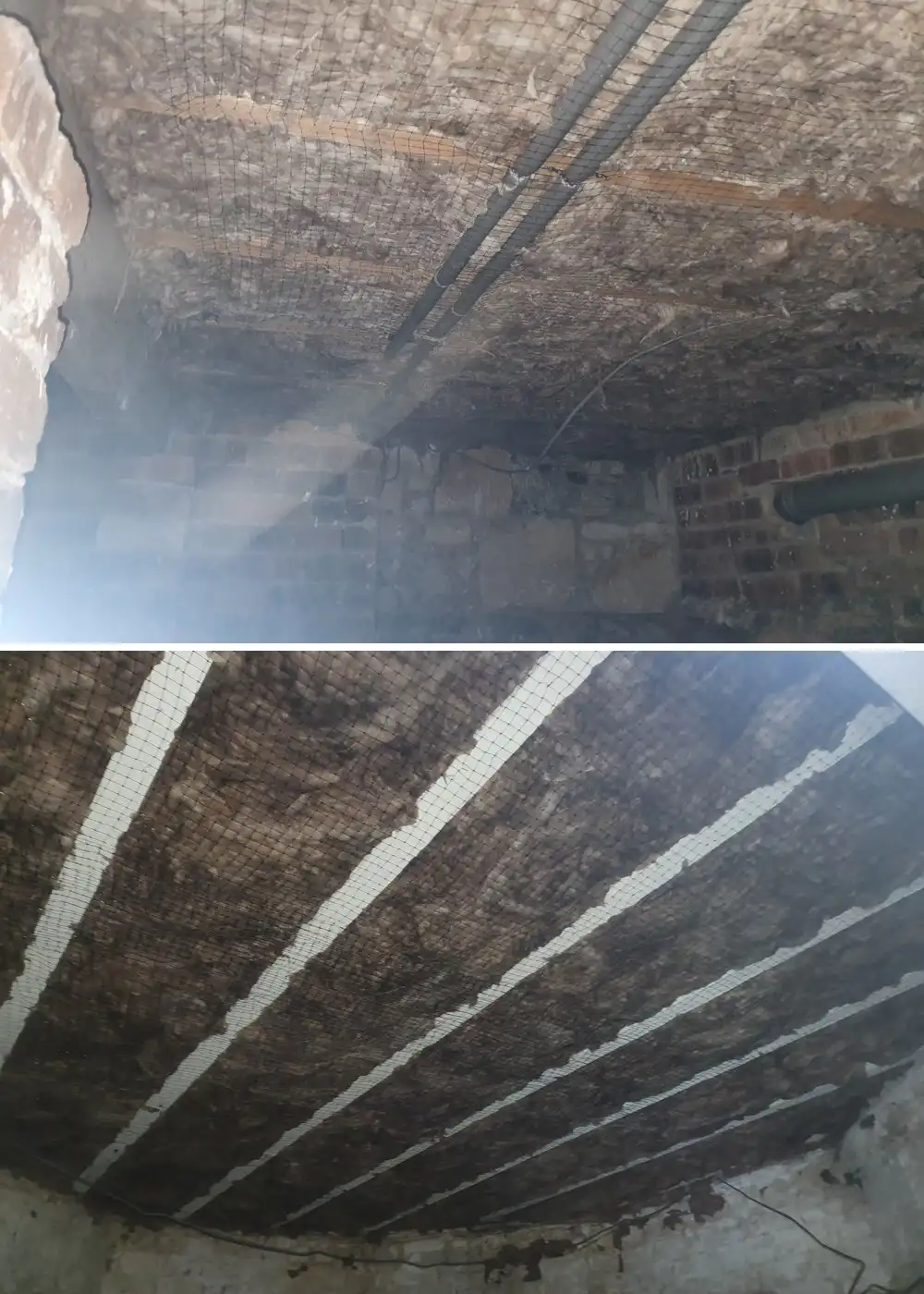
The crew fixes netting under the joists. It packs Knauf Omnifit 40 mineral wool above it. Any blocked vent gets reopened.
Air bricks kept clear We keep the air bricks (the small vents low in your outside walls) clear, so air keeps moving under the floor and the timber stays dry.Boards lifted and re-laid If we can’t get under the floor on a standard job, we lift your floorboards and put them back afterwards, taking extra care with old boards.
-
Step 4
Photos and Guarantee
You get photos of the wool in place. Your guarantee comes in writing. You also get our invoice and the installer paperwork for your claim. Home Energy Scotland needs an EPC after the work, which we can arrange. Then it pays the grant back.
Grant funding and EPC We help with your Home Energy Scotland grant if you qualify, answer your questions about it, and provide a new EPC after the work where you need one. -
The honest bit: which level your floor needs
The standard job suits most of the floors we see. The airtight job costs more, because we rebuild the whole floor with two membranes and taped joints, and the natural insulation costs more too. We will tell you which one your floor and budget call for, and the choice is yours.

How each system goes in
Underfloor Insulation Fitted Below Your Musselburgh Floorboards
Each card below shows one system building up layer by layer, the way we fit it. The pictures are illustrations.
Illustration: standard system
-
The cold void
Each line of light is a gap between your floorboards. Cold air from the air bricks comes up through those gaps and in at the skirtings, into the room you pay to heat.
-
Wool between the joists
We reach the void through one small hatch, and most floors take a day. Knauf Omnifit mineral wool, cut a touch wider than the space between joists, grips them and fills their full depth.
-
Netting underneath
Support netting fixed under the joists holds the wool up, so it can't sag over the years. We photograph it all for you, since you won't be crawling under there to look.
-
A warmer floor
On the first cold Musselburgh night after we've been, the boards under your socks feel warmer than they did last winter. Up in the room, the draught at the skirtings eases off and less heat escapes through the floor.
Standard underfloor insulation with Knauf Omnifit
When there is room to work in the void below, we fit it from underneath, so your floorboards stay down and the job is usually done in a day.
Our most popular option and superb value when there is access from below. We work in subfloor spaces as shallow as 350mm, fitting 150 to 200mm Knauf Omnifit 40 rolls friction-cut to fill the full joist depth, lagging the heating pipes and fixing insulation support netting underneath so it never sags. Ventilation is kept clear, airbricks are extended where needed, and every access hatch is insulated and screwed back down. A breathable membrane and airtightness tape can be added for extra performance.
 Illustration: hemp system
-
Boards up, one room at a time
We lift the floorboards to open up the joists.
-
A hammock between the joists
A thin sheet is slung between the joists and taped round its edges.
-
Hemp cut to fit
IndiTherm hemp is cut to sit snugly in each hammock.
-
Sealed, then boarded
A taped top sheet goes over the joists, then your boards go back down.
Hemp underfloor insulation with airtightness membranes
Hemp suits you if you want a natural, Scottish-made material and the best airtightness, and you are happy for the boards to come up room by room. It costs more than the standard job because the floor is lifted and every join is taped.
For a natural, higher-end floor we fit IndiTherm hemp, made in Scotland by IndiNature, working room by room. We sling a thin sheet between the joists like a hammock, tape it round the edges and cut the hemp to fit snugly inside it. A second sheet goes over the joists, taped down to keep moist room air out of the floor, before the boards go back. Installed from above it gives the highest performance with no compromise on airtightness.
 Illustration: PIR board system
-
Battens at your heating level
25mm treated battens are fixed to the joists at your heating design level.
-
Foil-faced board between the joists
PIR is cut tightly to fit between the joists and rests on the battens.
-
Foam edges, taped joins
Foam seals the perimeter and foil tape covers every join.
-
Heating on top
The pipes go in above the board. Then the floor goes back on top.
PIR insulation for underfloor heating
Underfloor heating laid over a cold, ventilated void loses heat downward unless there is insulation beneath it. A foil-faced foam board (PIR) under the heating sends that warmth back up into the room, where you want it.
We recommend high-performance foil-faced PIR, fitted on 25mm treated battens set to your heating design level and cut tightly between the joists, with airtightness foam sealing the perimeter and foil tape over every join. Most underfloor heating contractors do not hold the TrustMark certification for underfloor insulation, so we carry out this element, which keeps up to £1,500 of Home Energy Scotland grant open to you if you qualify. We are happy to work alongside your contractor or recommend a trusted partner.
Why Musselburgh Homeowners Pick Us for Draughty Floors
-

We find where the cold gets in
The survey checks the vents, the joists and the way in, so you know what’s driving the draught.
-

Vent extenders priced up front
A raised path can cover an air brick. The part that reopens it goes in your quote from the start.
-

One day on a standard floor
The crew fits the wool, lays back any boards it lifted and tidies up before leaving.
-

Your grant worked out in writing
The quote shows the price, the grant you could claim and the share left for you.
-

Fitting days booked ahead
Musselburgh is a long drive from our East Kilbride base, so we set survey and fitting dates in advance.
-
Along the coast from Portobello
We also fit underfloor insulation in Portobello, a few miles west of the Esk.


What Underfloor Insulation Costs in Musselburgh With the Grant
Mineral wool under a standard Musselburgh floor costs £1,400 to £2,500. With the full grant, your share is £350 to £1,000 once it comes back.
- GrantUp to 75%, capped at £1,500, if you qualify
- The grant is up to 75%, capped at £1,500 for a floor. On a £1,560 floor, 75% is £1,170, so your share is £390. Above £2,000, the grant stays at £1,500.
- Home Energy Scotland also offers an optional loan, up to a limit set for each measure.
- IndiTherm hemp is the natural choice, at £3,000 to £5,000, or a £1,500 to £3,500 share after the full grant.
- You pay our invoice. Home Energy Scotland pays the grant to you once it approves your claim.
- The grant is for homeowners who live in the home. Wait for the written grant offer before your fitting day.
- The grant line on your quote is an estimate. Home Energy Scotland decides who qualifies.
Home Energy Scotland’s grant limit for a whole home is £7,500, or £9,000 for a rural or island address. You only reach that with several jobs on one claim.
Three Guarantees on Every Musselburgh Floor
You get all three on a Musselburgh floor, from a flat to a villa.
What you get on every floor we insulate:

-
25-year workmanship guarantee
A 25-year workmanship guarantee.
-
TrustMark and PAS 2030 certified
Audited work that meets the standards the grant requires.
-
No deposit
No deposit before the work starts.
-
Payment on 7-day terms
Payment within 7 days of completion.
Ask your own questions about underfloor insulation in Musselburgh.
Hold your hand near the skirting on a windy day. If you feel cold air, call 0141 465 5812 and tell Calum where it’s coming in.
Underfloor Insulation in Musselburgh: Questions From Fisherrow to Inveresk
The questions we hear most.
It stops the draught coming up from the gap below. The wool fills the space between the joists, so far less cold air reaches the boards. Draughts round doors and windows have other causes.
£1,400 to £2,500 for a standard floor. With the full grant, your share is £350 to £1,000. Hemp costs more, and the boards come up for it.
Book Your Free Survey ↓Yes, if you own and live in the home. Home Energy Scotland pays up to 75%, capped at £1,500. It decides who gets it and only funds TrustMark-registered installers.
Book Your Free Survey ↓From below where the crew can crawl in, from above where it can’t. Netting goes under the joists, mineral wool goes on top, and the vents stay open.
Rot is far less likely while air still moves under the house. The crew keeps every vent clear and reopens any that a path has buried.
One day for a standard floor. The survey tells you how long yours will take.
Yes, all three. Survey and fitting days go in the diary ahead, and the crew travels through from East Kilbride.
Book your free underfloor survey.
Tell us about your floor and we will be in touch to arrange a survey.


