


Internal Wall Insulation in Motherwell for Stone Villas
Google review
-
Stripped to the stone
-
A lime parge
-
Hemp in the frame
-
Wood-wool board
-
Lime plaster with mesh
-
Finished and painted
 Illustration: a vapour-open system on a stone wall
-
Stripped to the stone
-
A lime parge
-
Hemp in the frame
-
Wood-wool board
-
Lime plaster with mesh
-
Finished and painted


Solid Wall Insulation in Motherwell and the Room You Save for Best
The best room in an old Motherwell villa is often the coldest.
-
High ceilings, a big bay and solid stone walls lose heat fast.
-
Internal wall insulation in Motherwell fixes that, but two worries come first.
-
One is the cornicing.
-
Lining an outside wall brings it about 120mm into the room. The cornicing on that wall has to come down and be made again.
-
The other is damp.
-
Stone soaks up rain and dries out again through lime.
-
Foam board glued to the inside slows that right down.
-
Damp can then gather where the floor joists sit in the wall.
-
The stone villas along Hamilton Road were built to last.
-
A cheap lining can undo that in a few winters.
Cheap jobs are not rare.
The National Audit Office looked at wall insulation done under ECO4 and GBIS. Around 29% of internal jobs had major defects, and around 98% of external ones, in more than 30,000 homes.
We fit a hemp and lime lining for stone walls. Damp can still pass out through every layer.
- Lime parge goes on first to even out the stone.
- Scottish-made IndiTherm hemp sits in a 45mm timber frame.
- Wood-wool board covers the hemp.
- Two coats of lime plaster go on last.
Builders call that vapour-open.


Our process
Our Process in Motherwell, From Survey to the Last Lime Coat
We start with a free survey of your walls, and you see the two systems we fit before anyone strips a wall.
-
Step 1
Free Survey and Tailored Design
Calum or Lewis, our surveyor, walks each room with you. They note the stone, the damp and the features on every outside wall. Your written quote sets out each option. You then apply to Home Energy Scotland with it.
-
Step 2: the split
The honest comparison
Your wall’s material, finish and modelling decide which of these two systems suits it.
-
Right for most stone
Natural system that lets stone dry
Lime + hemp or wood wool
Illustration: vapour from the room passes through each layer and the stone keeps drying. - + The wall keeps drying out
- + Can mostly be taken out again later, and keeps the stone healthy
- + Right for most solid sandstone walls
- − Costs more and takes longer to prepare and fit
- − Thicker, so you lose a little more room
-
On the right wall
Membrane system that keeps room moisture out
Pro Clima membrane + insulation
Illustration: the membrane holds vapour from the room back, before it reaches the wall. - + For brick that soaks up little water, or brick that is rendered or painted
- + Can be thinner in some cases
- − Only used where our moisture modelling shows it is safe
- − Wrong for a normal sandstone wall, which soaks up water
-
-
Step 3
Specialist Installation
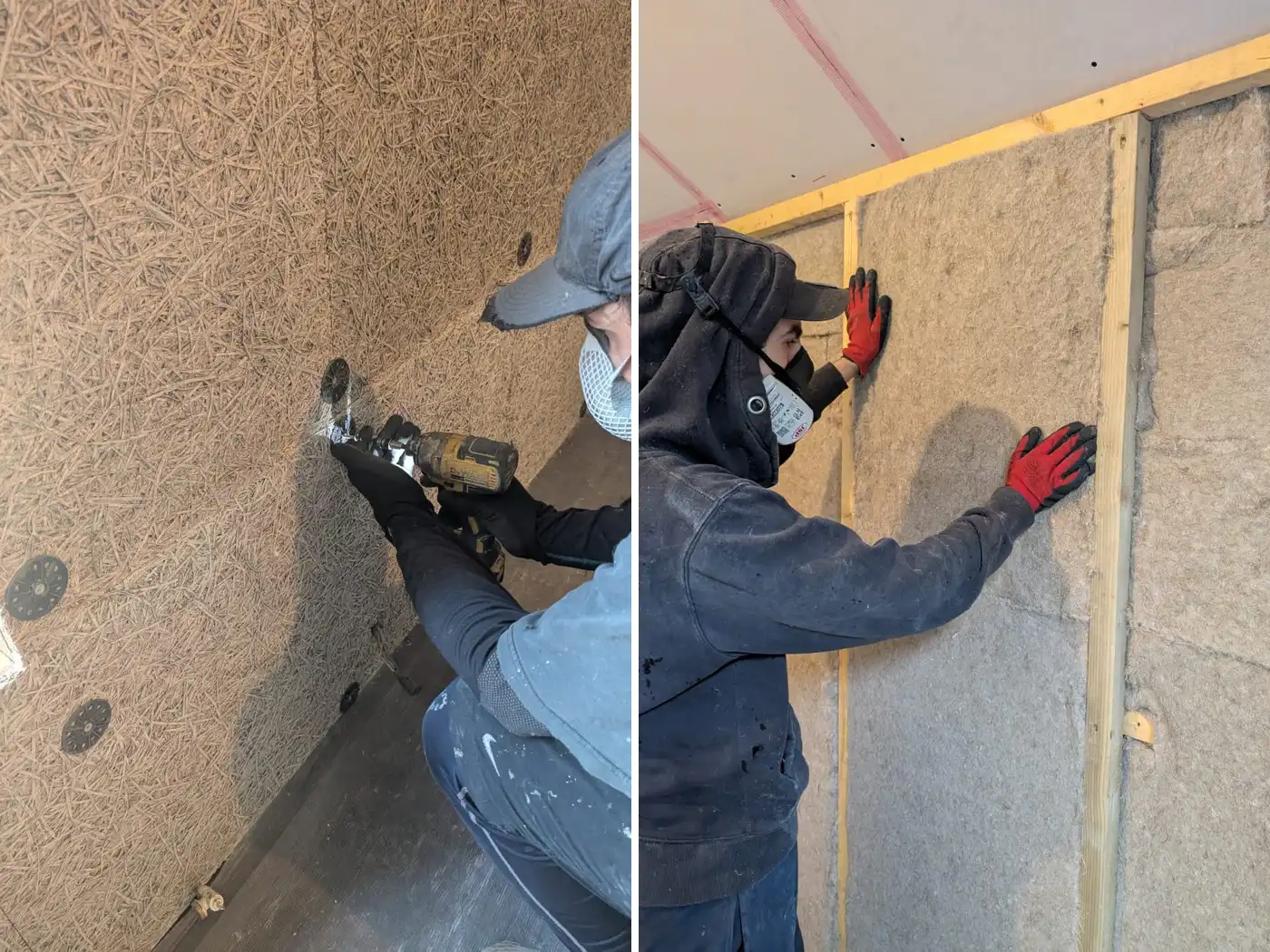
When the grant offer comes in writing, we take the wall back to bare stone. A lime parge fills the gaps and flattens it. Two 50mm layers of Scottish hemp are pressed to 90mm inside a 45mm timber frame. Then come wood wool board and two coats of lime plaster.

-
Step 4
Aftercare and Guarantee
You get photos of each layer before it’s covered. We tell you which paints suit lime. A new EPC follows. The grant is paid after that. Your 25-year workmanship guarantee comes at handover.
-
Where we say no
What we will not do
Foam board glued onto sandstone
We won’t glue a sealed polystyrene or foam board onto a solid sandstone wall to bring the price down. If that is the only way to a cheaper quote, we will tell you so and advise against it.

Inside the wall
Your wall, insulated layer by layer
Each card shows one build going onto a wall, from bare masonry to a finished room, in the order our fitters work. The pictures are illustrations.
Illustration: heritage system
-
Stripped to the stone
Our fitters strip the old plaster and timber laths back to bare sandstone, so no hidden wood is left to rot. Cornicing on these walls comes down too, and is remade in lime after the insulation goes in.
-
A lime parge
Then a coat of lime, called a parge, goes over the stone. It fills the hollows where damp air could sit and turn to water.
-
Hemp in the frame
Our fitters press two 50mm layers of Scottish-made IndiTherm hemp into a 45mm timber frame fixed over the lime. This is the layer that keeps the heat in your room.
-
Wood-wool board
Wood-wool board, a stiff sheet of bound wood shavings, goes over the hemp next. It gives the lime plaster a solid face to grip and still lets moisture pass through.
-
Lime plaster with mesh
Lime plaster goes on next, with a mesh bedded into it.
-
Finished and painted
A smooth lime finish leaves the wall about 120mm further into the room than before. At handover you get paint guidance, so the finish keeps letting the wall dry.
Hemp, wood wool and lime on bare sandstone
This vapour-open build suits most solid sandstone walls. Each layer lets moisture pass, so the stone behind it can keep drying out.
 Illustration: membrane system
-
Stripped back to brick
The old plaster comes off the inside of the wall, back to the brick.
-
Hemp packed into a frame
Our fitters pack hemp insulation into a timber frame fixed over the brick.
-
The Intello Plus membrane
A Pro Clima Intello Plus membrane goes across the frame to keep room moisture out of the wall.
-
Plasterboard and skim
Plasterboard goes over the membrane, and a skim coat finishes the wall.
Hemp and a membrane for the right brick wall
Some walls are brick, and where that brick is rendered or takes up little water, a sealed build can suit it better.
It finishes in plasterboard and a skim coat, so it goes in faster than the lime build.
At your survey, Calum or Lewis checks each outside wall, and Calum tells you which build each one suits.
Why Motherwell Villa Owners Choose Us
Insulation planned around how your Motherwell walls take in damp and dry out.
-

Cornicing planned before the wall comes down
At the survey we record the cornicing on each wall we’ll line. You know what comes down and what goes back before any work starts.
-

Old stone checked for damp first
We look at the pointing, the gutters and any damp patches. Anything that needs fixing first goes in your quote, so it isn’t a surprise later.
-

Tested layers, picked for your stone
Your build-up comes from designs already tested in WUFI. That program models how damp moves through a wall over many years.
-

We make less on hemp, and fit it anyway
Hemp and lime cost more than foam board, so we make less on a hemp job. We still fit them, because stone has to keep drying.
-

A short drive from our base
Motherwell is close to our East Kilbride base. We line stone villas and cottages in Hamilton too. The crew and lime plasterer are the same.
-

On the list the grant needs
Home Energy Scotland only pays for solid wall work by a TrustMark-registered installer. We’re on that register.
The honest bit: period features
Cornicing, shutters and panelling on the walls we insulate have to come off, and they can’t be saved. Cornicing on walls we don’t line stays. Once the insulation is in, our specialist lime plasterer remakes the plaster mouldings and our joiner remakes the woodwork.

Internal Wall Insulation Cost in Motherwell, and What the Grant Pays
Lining stone walls costs £10,000 to £50,000. Typical jobs land between £14,000 and £25,000. The number of walls and features sets the cost of internal wall insulation.
So does the plaster.
- GrantUp to 75%, if you qualify
- Walls cap£7,500 in any postcode
You pay our invoice in full. Then the grant comes back to you. Say your job costs £20,000. The grant tops out at £7,500, so your share is £12,500 once it comes back.
- If you qualify, Home Energy Scotland’s main grant pays up to 75% of the job, capped at £7,500.
- Home Energy Scotland also offers an optional loan, up to a limit set for each measure.
- The grant is for owner-occupiers who live in the home.
- You apply, and Home Energy Scotland decides who qualifies.
- Work waits for its written offer.
- You get our invoice and the installer paperwork for your claim.
Rated 5.0 on Google by homeowners across central Scotland.


Solid stone walls need to dry out, and foam board stops them.
-
1Bare solid stone
Old solid stone walls handle damp the way they always have: they soak it up, then let it dry off both the inside and the outside. They have no cavity and no plastic layer, and that works for as long as the wall can keep drying.
-
2Foil-faced foam board
Foil-backed plastic foam board or sealed foam stuck straight onto the inside of the wall stops that drying. Warm, moist air from your rooms still reaches the cold stone behind it, turns to water and has nowhere to go. That trapped water causes the damp people blame on insulation.
-
3Vapour-open build-up
Our system uses lime, hemp and wood wool, which let that moisture pass through and dry off (the trade calls this vapour-open). When we plan the layers for your wall, it stays warm and keeps drying.
Internal wall insulation in Motherwell, with the damp risk checked first.
Our designs come from WUFI modelling, computer software that tracks how heat and damp move through the wall layers over several years. A solid wall needs that long to settle to a steady moisture level: roughly five years for brick and ten for stone.
-
About 5 yearsbrick, drying to equilibrium
-
About 10 yearsstone, drying to equilibrium
For a typical stone wall, we use a set of layers we have already modelled. We model a larger, listed or unusual building from scratch, and quote that as a separate service. Either way, we can show you the damp risk as a figure on paper.
Ask your own questions about internal wall insulation in Motherwell.
Worried about the cornicing in your front room? Ring Calum before you book anything. He’ll talk you through what a lining means for that room.
Ballagan Farm, Strathblane
A two-storey farmhouse under full renovation, where poor insulation had left the walls damp. We stripped the walls back to bare stone and gave them a thin coat of lime. Then we fitted IndiTherm hemp and wood-wool boards and finished the sloping ceilings and the solid sandstone walls in lime plaster. We insulated the loft with Knauf Earthwool 44.
Auchinlay House, Dunblane
An internal wall and room-in-roof project for a homeowner getting ready for a heat pump, who wanted the bedrooms comfortable all year. On the walls we used hemp, wood-wool board and lime plaster, which let the wall dry. The sloping ceilings and dormers got a sealed system of PIR foam board and Superfoil SF19+, and the upper loft got Knauf Earthwool.
Mount Hope, Bridge of Allan
The client was renovating an old sandstone wing of their period home. We fitted 100mm Sisalwool, wood-wool board and lime plaster on four walls, which lets the stone dry. On one large gable wall we took out the dropped ceiling and built an insulated vaulted ceiling in its place.
Belhaven Terrace Lane, Glasgow
A West End owner wanted the whole house warmer. We insulated the ground-floor walls from the inside and the upstairs bedrooms in the roof space. The stone walls got layers that let them dry, because this sandstone soaks up a lot of water. In the sloping ceilings, a sealed layer stops warm, moist air reaching the roof spaces.
Observatory Lane, Glasgow
Internal wall insulation for a client of Oscar J Murray Architects, part of a whole-house renovation in Glasgow’s West End. We fitted IndiTherm hemp on the stone walls, dormers and sloping ceilings, and finished the walls in lime plaster. A Pro Clima Intello membrane went on the sloping ceilings, and Contega Solido tape seals the gaps round the windows.
Protected, and built to the standard the grant requires.
Our workmanship is guaranteed for 25 years. If our workmanship fails, we come back and put it right. We take no deposit, so nothing is paid up front. Payment is on 7-day terms: you are invoiced after completion, once you have seen the finished work and the photographs, and pay within seven days.
We’re TrustMark registered and PAS 2030 accredited, with a 25-year workmanship guarantee.

-
25-year workmanship guarantee
If our work fails, we come back and put it right.
-
TrustMark and PAS 2030 certified
Audited to the standards the grant requires.
-
No deposit
You pay nothing before we start.
-
Payment within 7 days of completion
The invoice comes once your walls are finished.
Internal Wall Insulation Questions From Motherwell Villa Owners
Straight answers on cost, grants, systems and coverage area.
Typical jobs come to £14,000 to £25,000. With the full £7,500 grant back, your share is about £6,500 to £17,500. The survey prices your own walls.
Each option in the quote comes with its own price and the honest case for it.
Book Your Free Survey ↓Cornicing and plaster mouldings on the outside walls come down. They are recreated in lime once the insulation is in, and at the survey we agree exactly who does that work. Cornicing on inside walls stays where it is. Shutters and skirtings need the same plan when we line walls that have period features.
It’s far less likely with hemp and lime. Both let damp pass, so the stone keeps drying, as old stone walls need to. Foam board sealed onto stone can trap it.
Calum or Lewis checks for existing damp on the survey visit, so point out any patches you have noticed.
Book Your Free Survey ↓Yes, if Home Energy Scotland accepts your application. Its main grant pays up to 75% of the work, capped at £7,500. A TrustMark-registered installer must do the job.
Check your eligibility with Home Energy Scotland, then book the survey so your application has a written price behind it.
Book Your Free Survey ↓Generally around one to three weeks. It depends on how many walls you line. Each lime coat needs time to dry, and we put your dates in writing.
Not usually, because the work is inside. Hamilton Road is a conservation area, and its rules mostly cover the outside. A listed villa is different: check with the council before any work starts.
Have any earlier consent papers or council letters to hand on the survey day, so we can plan the paperwork around them.
Book Your Free Survey ↓Yes. Both are a short drive from East Kilbride. We survey each older stone home the same way, wall by wall.
Book Your Free Survey.
Tell us about your property and we will be in touch to arrange a survey.


