


Wood fibre, wood wool and hemp all turn up when you look into natural wall insulation. All three let a stone wall dry. They still do different jobs. Hemp batts fill a timber frame and do the insulating. Wood fibre boards insulate too, in a frame or fixed to a flat wall. Wood wool board is a thin, tough board that lime plaster grips. On sandstone we parge the stone flat in lime. Then we fit hemp in a frame, with a 15mm wood wool board on top.
- Wood fibre, wood wool and hemp are all vapour-open, so each one lets a stone wall dry.
- Hemp batts insulate, and they sit in a timber frame.
- Wood fibre boards insulate too, either in a frame or fixed to a flat, plastered wall.
- In our walls, a 15mm wood wool board holds the plaster and the hemp keeps the heat in.
- We parge the stone in lime first to fill and flatten it, so the frame sits tight with no air gap.
- If you qualify, the wall grant covers hemp or wood fibre alike, capped at £7,500 in every postcode.
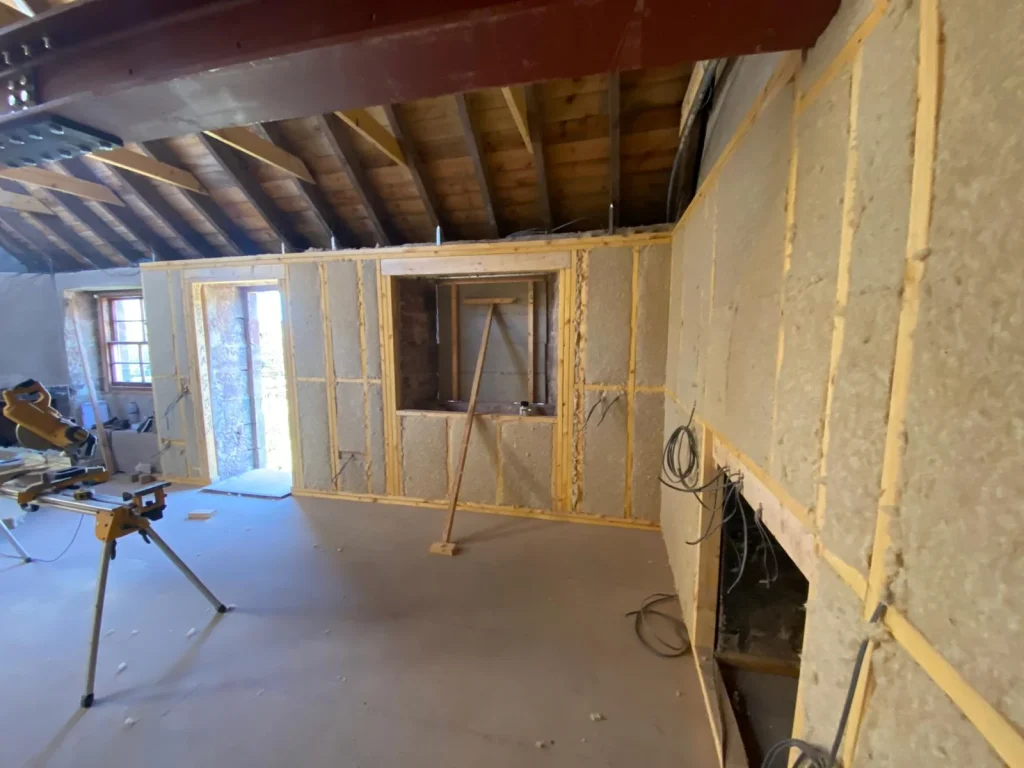
Hemp in a timber frame on a wall under renovation.
Two of the names sound alike. Wood fibre and wood wool both start as timber, yet on a wall one mainly insulates and the other mainly holds the plaster. Once that is clear, the choice for your own wall gets simpler.
Natural wall insulation: which material does which job

Board fixed across a wall around a window, one layer of the build-up.
Natural wall insulation goes on the inside of a stone wall, in layers. Some layers keep the heat in. Some give the plaster a face to hold on to. Each material below fills one or both of those roles.
Hemp.
Soft batts that insulate. They sit in a timber frame.
Wood fibre.
Batts or stiff boards that insulate. Some boards can take plaster on their face.
Wood wool.
A thin board of wood strands. It holds the plaster.
Sheep’s wool and Sisalwool.
Soft batts like hemp. Sisalwool, made in Scotland from sisal and wool, costs more.
All of them let water vapour pass. That is the line that splits them from foam boards. Our guide to vapour-open and vapour-closed systems explains why that matters on stone.
Hemp: the insulation inside the frame

Hemp pressed into a timber frame on a wall.
We fit IndiTherm hemp, made in Scotland by IndiNature. First, the bare stone is given a lime parge, which levels out its dips. Then two 50mm layers of hemp go into a 45mm timber frame, compressed to 90mm. That way the hemp covers the timber too.
Good at:
fitting tight in a frame with no gaps, and taking up damp and giving it back.
Good at:
covering the timber, so the frame does not become a cold line.
Watch out for:
with the frame, board and plaster, you lose about 120mm of room.
Watch out for:
it costs more than foam board and needs more depth for the same warmth.
For where else hemp goes in a home, and what each job costs, see our guide to IndiTherm hemp insulation.
At the free survey we check how sound and how even your stone is, and which build-up suits it.
Book Your Free Survey →“After spending lots of time helping me access my insulation options on our detached sandstone period property, we had underfloor insulation installed.”
Chris Hannah
Google review
Wood fibre insulation: in a frame or on a flat wall

A stone wall with its lime parge coat, the face the insulation sits against.
Wood fibre insulation is wood broken down into fibres and pressed into soft batts or stiff boards. Historic Environment Scotland lists two ways to use it on an inside wall. Thick wood fibre boards can sit in a timber frame, the same way our hemp does. Wood fibre can also fix straight onto a wall that was plastered flat onto the stone.
Good at:
letting vapour pass and taking up damp, much like hemp.
Good at:
some boards can carry lime plaster on their face, which can save a layer.
Watch out for:
fixed straight to the wall, the board needs a flat, sound face. Bare rubble needs a lime parge first.
Watch out for:
like hemp, it costs more than foam board and needs more depth for the same warmth.
Wood fibre is on our list of materials for jobs where a wall’s depth or warmth target suits it. The survey tells us which walls those are.
Wood wool board: what it does in the wall
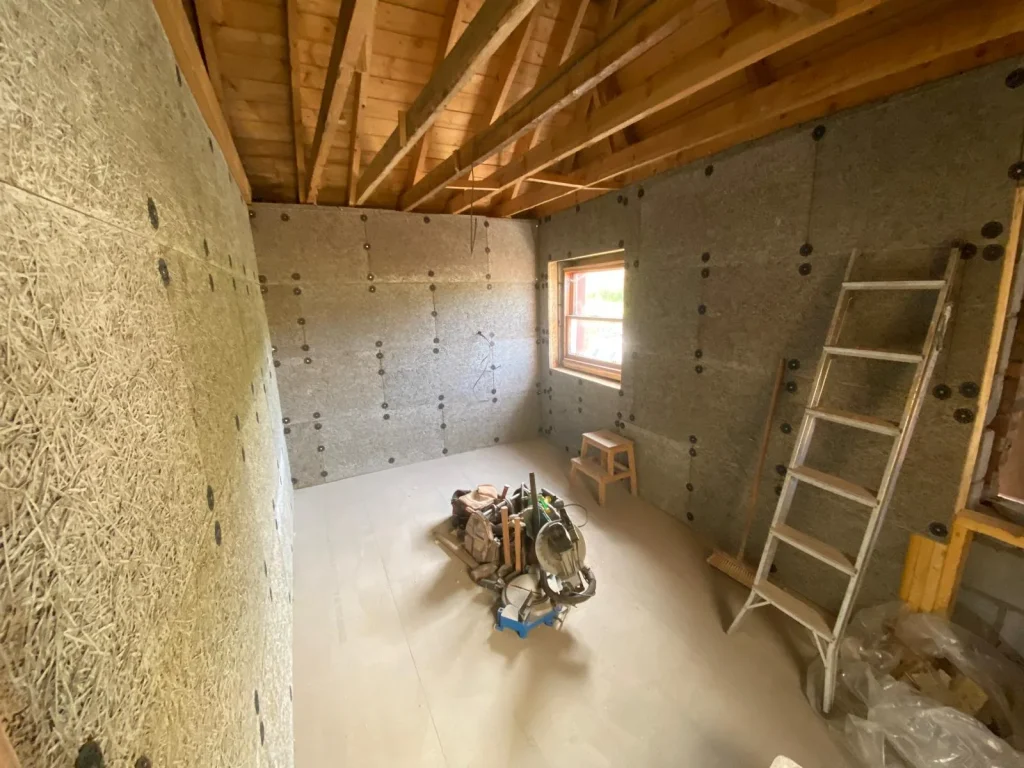
Wood wool board fixed across the walls of a room, the strands showing at the edge.
Wood wool board is made of long wood strands. People search for wood wool insulation, but in our walls the board has one job. It holds the lime plaster. The first of two coats pushes into the gaps between the strands and grips as it sets. At 15mm the board adds little warmth. The hemp behind it keeps the heat in.
Our vapour-closed system, for rendered or hard brick walls, uses plasterboard here instead, finished with a skim. Behind it, Pro Clima’s Intello Plus membrane controls the vapour. On sandstone we want lime, and wood wool gives lime the face it needs.
Our hemp and PIR comparison says more about the board and why it suits lime.
Ask to see wood wool board and hemp side by side at your free survey.
Book Your Free Survey →“The initial survey was arranged promptly and Nathan was able to answer all of my technical queries on the spot and was very knowledgeable.”
A Sville
Google review
Why we pair hemp with wood wool on sandstone
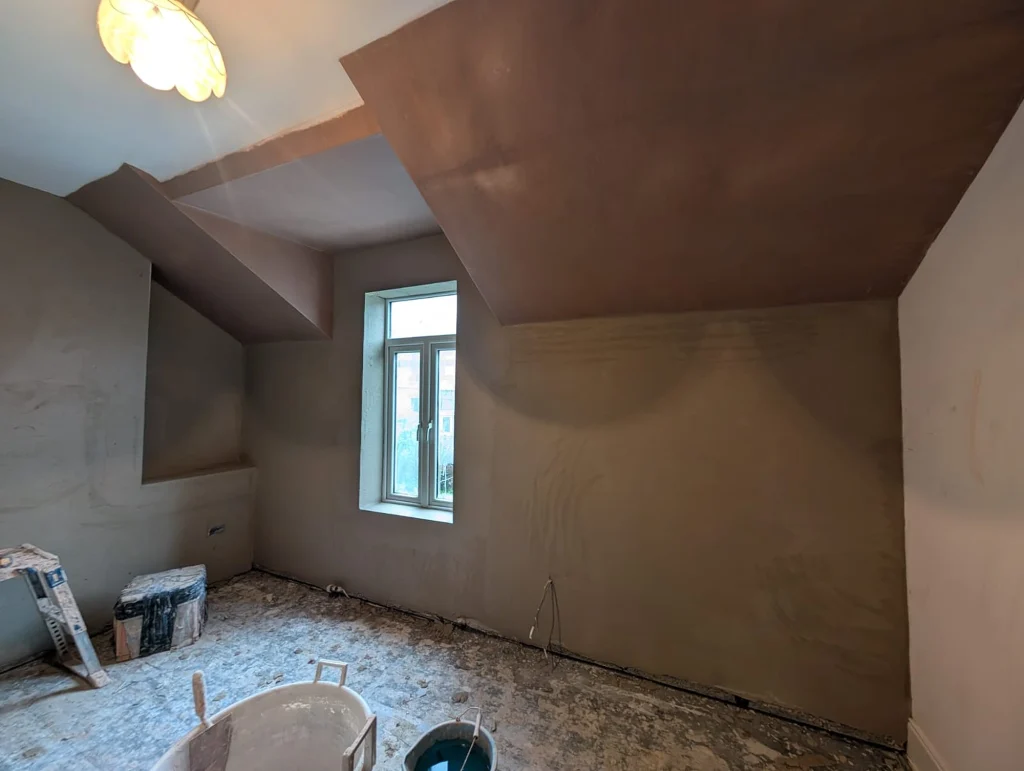
Lime plaster over the wall and slopes, the last layer of the build-up.
Inside a room, old sandstone is rarely flat, and rubble walls bulge. A frame fixed over those dips would leave air trapped in them. So the parge goes on first and builds the low spots up to meet the high ones. The frame then goes up hard against the lime, with nothing hollow behind the hemp.
Lime parge, hemp in a frame, wood wool board, lime plaster. The soft batts press tight round the timber and cover it. Three layers go on over the parge.
Wood fibre board, in a frame or fixed to a flat wall, then plaster. One board insulates and, with some types, carries the plaster. Fixed straight on, it needs a flat, sound wall face.
We have fitted our sandstone system on stone homes across Scotland. Where a wall’s depth or warmth target suits wood fibre better, we will tell you so at the survey.
See the layers on our internal wall insulation page, from bare stone to plaster.
What natural wall insulation costs

A finished lime-plastered room.
Expect £10,000 to £50,000 for a vapour-open heritage wall. Where a client goes ahead with us, the bill is often £14,000 to £25,000. The material is only part of that. Stripping, parging, lime plastering and putting back the joinery are in the price too.
Any vapour-open insulant counts.
Hemp and wood fibre both fall under solid wall insulation.
The order matters.
You get an EPC, apply to Home Energy Scotland, and wait for the written offer before any work starts.
We invoice you in full.
After the work and a post-install EPC, Home Energy Scotland pays the grant back to you.
A TrustMark installer
must fit it. Home Energy Scotland also offers an optional loan, up to a limit for each measure.
The grant pays up to 75%, capped at £7,500 for the walls. That cap does not rise in a rural postcode. The £9,000 rural cap is for a whole-house total only.
Our internal wall insulation cost guide breaks that figure down.
Book the free survey for a written quote that names the material on each wall and the grant against it.
Book Your Free Survey →“Insulation Installers Scotland did an amazing job. They were responsive, knowledgeable and respectful of my home.”
Gavin Moore
Google review
Natural wall insulation: common questions

Wood wool board fixed across the walls of a room, the base the lime plaster goes onto.
Is wood fibre better than hemp?
Neither wins on every wall. Both let a stone wall dry, and both can sit in a timber frame. We fit hemp as our main insulant because soft batts press tight round the timber. Wood fibre suits some jobs, and the survey decides.
Is wood wool board insulation?
It adds a little, but that is not its job in our walls. At 15mm it holds the plaster. The hemp behind it does the insulating.
Can wood fibre go on a stone wall?
Yes. Historic Environment Scotland lists wood fibreboard in a timber frame, or wood fibre fixed to a wall plastered flat onto the stone. Bare rubble or sandstone needs a lime parge first, to bring it level.
What is the best natural insulation for internal walls?
On Scottish sandstone we choose IndiTherm hemp, set in a frame over a lime parge and finished with wood wool and two coats of lime. Where a wall’s depth or warmth target suits wood fibre, that is a fair choice too.
Is natural insulation more expensive?
Yes, it costs more than foam board. A heritage wall job runs from £10,000 to £50,000 before the grant, and natural materials need more depth for the same warmth.
Does natural wall insulation get the grant?
Yes, if you qualify. Home Energy Scotland funds the solid wall job up to 75%, capped at £7,500 in every postcode, and a TrustMark installer must fit it.
Put your own wall to the test: book the free survey and we will tell you which natural build-up suits it.
Book Your Free Survey →“The service, communication, advice and installation was all done very well. I was pleasantly surprised at how professional and helpful they were.”
David Forrest
Google review
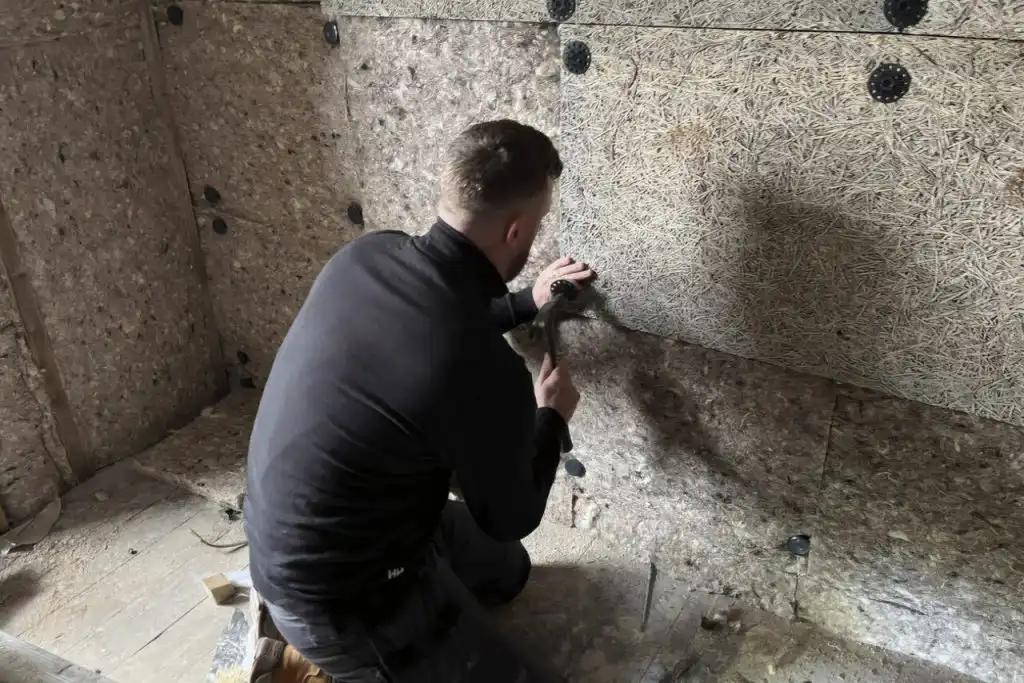
Fixing board to a wall.
See which natural build-up suits your walls
We check how sound, how even and how damp each wall is. Then we tell you which materials go on it, and what your share comes to once the grant is back.
Your written quote follows by email.
Or call us on 0141 465 5812


